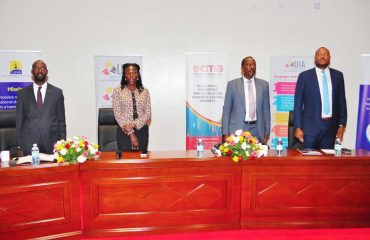

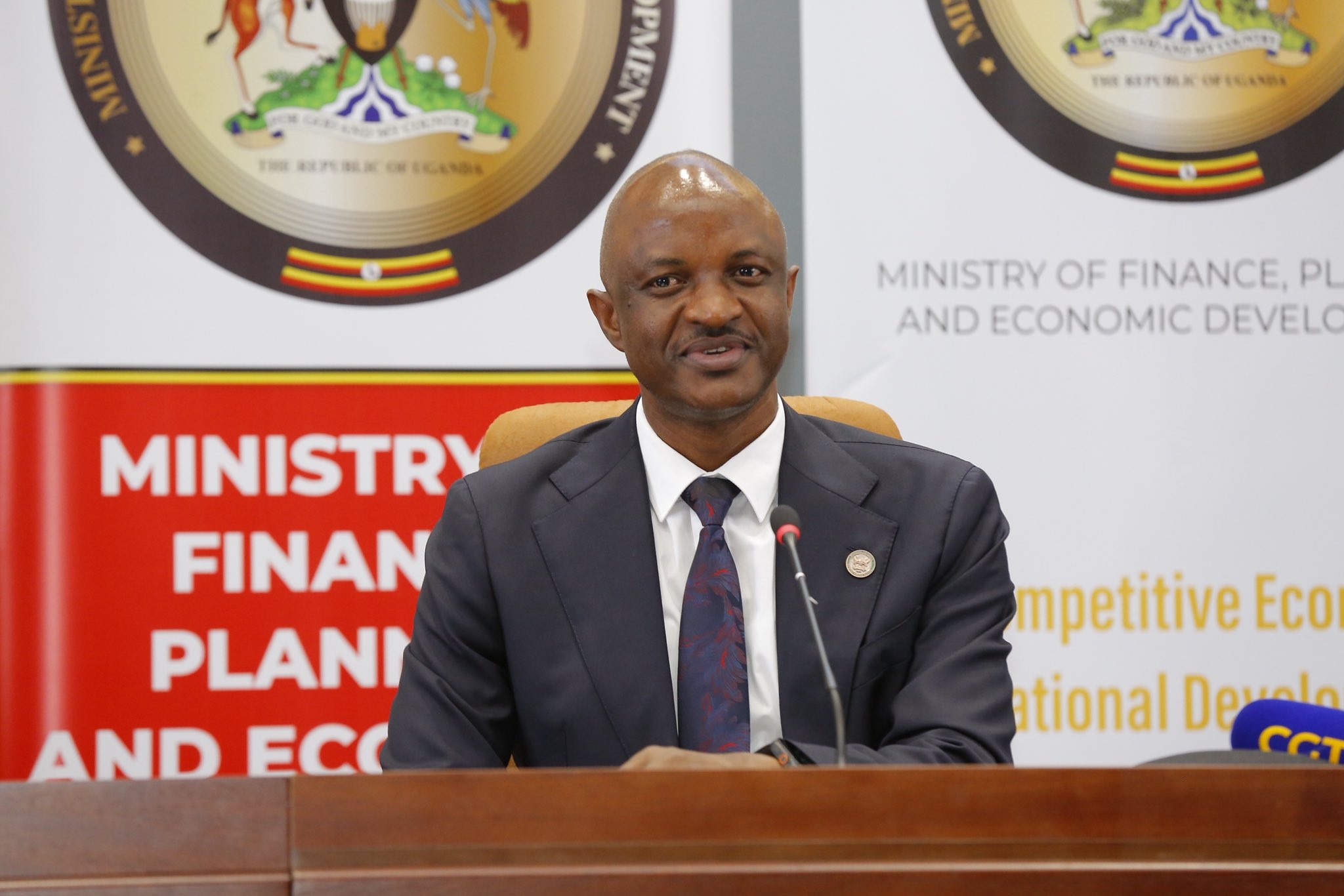
- I wish to welcome the media and other stakeholders to this press briefing for the release of the FY 2025/26 Fourth Quarter Expenditure Limits.
- The Quarter Four expenditure limits for this Financial Year come after the country has successfully concluded the 2026 General Elections and is now, along with the rest of the world, going through uncertainty caused by geopolitical tensions in the Middle East.
- In view of this timing, the Quarter Four Expenditure Limits have been informed by our need to sustain the momentum for implementation of the Tenfold Growth Strategy but within the framework of our fiscal consolidation agenda. The agenda puts emphasis on implementation of Government’s objective of sustaining macroeconomic stability and maintaining fiscal discipline.
- Therefore, the following principles have been considered in programming the FY 2025/26 Fourth Quarter Expenditure Limits:
- Maintaining total expenditures within the available resources;
- The need to achieve high economic growth by sustaining financing to wealth creation and highly critical priority actions within the ATMS, i.e. Agro-industrialisation, Tourism development, Mineral development, and Science, Technology, and Innovation;
- The need to sustain investment in the enablers of growth, especially security, infrastructure and human capital development; and
- Providing for the minimum required critical operational expenditure for all Ministries, Departments, Agencies and Local Governments.
- The objectives of this press briefing therefore are to:
- Brief the country on the state of the economy;
- Communicate to the country the release of funds to Government institutions for the Fourth Quarter (Q4) of FY 2025/26; and
- Provide guidance to Accounting Officers on execution of the budget.
- Let me start by summarising the state of the economy.
- STATE OF THE ECONOMY
- Despite global and regional geopolitical tensions, Uganda’s economic performance is resilient and the outlook is positive.
Economic Growth
- Preliminary estimates show that the economy expanded by 8.5 percent in the second quarter of FY 2025/26, from 5.4 percent recorded in the same period during FY 2024/25. The average economic growth for the first half of FY 2025/26, therefore, increased to 6.7 percent from 5.8 percent during the same period last year.
- This strong performance was primarily driven by robust aggregate demand, investment and exports, reflected by increased production in the industrial, services, agriculture, forestry and fishing sectors of the economy. On average, in the first half of 2025/26, the industry sector grew by 9.1 percent, up from 6.4 percent in the same period last year, supported by increased activity in manufacturing, construction, and electricity production.
- Aggregate demand and investments in the first half of FY 2025/26 increased by 15.2 percent and 14.4 percent compared to 6.2 and 5.3 percent, respectively, in the same period, the previous financial year. Other factors which contributed to higher growth include continued implementation of Government programmes to support household production and productivity, and small, medium and large-scale businesses, along with improved performance in tourism receipts and Foreign Direct Investment (FDI) to support oil and gas activities.
- GDP growth is expected to accelerate between 6.6 percent to 7.0 percent this FY 2025/26, up from 6.3 percent in FY 2024/25. By end of June 2026, GDP is projected at USD 68.4 billion (Shs 251.4 trillion), equivalent to USD 194.2 billion in Purchasing Power Parity (PPP) terms. GDP per capita is projected at USD 1,399 (Shs 5.03 million) in June this year.
- The drivers of this positive outlook include the Parish Development Fund (PDM) and Emyooga, infrastructure investments, increased FDI (especially in oil and gas and the ATMS), commencement of oil production, political stability, export growth, and a stable macroeconomic environment.
- With the commencement of oil production later this year, double-digit growth is projected in FY 2026/27.
A Strong Shilling
- The Ugandan shilling has performed strongly, reflecting prudent economic management: an open capital account, diversified exports, a liberalised foreign exchange market, and an active FDI policy. The recent Government decision to import refined petroleum products directly from producers has also contributed to the strengthening of the shilling. Above all, the sustained peace and security in the country has been a strong contributory factor. The shilling is projected to remain strong and stable, despite recent mild depreciation pressures driven by speculation around the conflict in the Middle East.
- Our foreign exchange fundamentals remain strong and robust as the shilling depreciated slightly to Shs 3,762.6 per US dollar as of end March 2026.
Investor Confidence and Optimism
- High-frequency indicators show improved investor confidence and trust in Uganda’s economy. This is mainly on account of political and economic certainty, apart from the high return on investment of 14 percent on average.
- Uncharacteristically, both local and foreign investors have shown confidence and optimism in Uganda’s economy during an election year!
- High-frequency indicators also point to continued economic strength. In the first three quarters of FY 2025/26, the Purchasing Managers’ Index and Business Tendency Index remained above the threshold of 50, averaging 53.7 and 57.6, respectively, indicating sustained business expansion and positive sentiments about the business environment. The Composite Index of Economic Activity also increased to an average of 181.55 in the first eight months of FY 2025/26 from 169.61 in the same period last financial year, reflecting higher overall economic activity.
Inflation
- Annual headline inflation remains subdued, averaging at 3.3 percent this financial year. This was the same rate recorded over the same period in the previous financial year. This stability has been mainly supported by the appreciating shilling against major global currencies and the declining global inflation, which slowed the inflation of imported goods in the first half of this financial year.
- For FY 2025/26, inflation is expected to remain below the 5 percent target.
External Sector
- Our external position continues to strengthen, with foreign exchange reserves growing to USD 5.9 billion or an equivalent of 4.1 months of import cover as of January 2026. This was driven by robust FDI, particularly in the oil sector, and growth in portfolio inflows.
- Similarly, remittances from Ugandans in the Diaspora continue to improve, amounting to USD 807.32 in the first half of FY 2025/26.
- EXPENDITURE LIMITS FOR THE FOURTH QUARTER OF FY 2025/26
- The total release for Quarter Four for FY 2025/26 amounts to Shs 17.444 trillion. This brings the cumulative total release for FY2025/26 to Shs 77.001 trillion which is 106.4% of the approved budget and 95.1% of the revised budget.
- The highlights are as follows:
Statutory Obligations and Institutions
- Shs 6.38 trillion for debt and treasury operations;
- Shs 2.04 trillion to cater for wages and salaries across Government;
- Shs 343.39 billion for Pension and Gratuity;
- Shs 204.04 billion for Parliament;
- Shs 73.01 billion for the Judiciary; and
- Shs 12.66 billion for the Office of the Auditor General.
ATMS to drive tenfold growth
- Agro-industrialisation (A) – Shs 314.9 billion for agro-industrial research and innovation, especially fast-tracking the rollout of the anti-tick vaccine, operations and critical programme interventions;
- Tourism Development (T) – Shs 48.6 billion for tourism development and promotion interventions, including the “Explore Uganda” drive, and development of Uganda Martyrs Shrine, Namugongo.
- Mineral-Based Industrial Development including oil and gas (M) –Shs 24.3 billion to the Petroleum Authority of Uganda (PAU) forcontinuing the implementation of interventions towards fast-tracking first oil; and
- Science, Technology and Innovation including ICT and the creative industry – Shs 184.5 billion for expanding internet connectivity and digitisation of the economy.
Enablers of the ATMS
Wealth Creation
- We have released all the remaining balances for the Parish Development Model amounting to Shs 542.3 billion.
- Also, the remaining balance of Shs 74.7 billion for other wealth creation funds has been released, including: The Agricultural Credit Facility (ACF) – Shs 7 billion; Interest payments to large-scale farms – Shs 4 billion; Capitalisation of Uganda Development Bank (UDB) – Shs 13 billion;and Capitalisation of Uganda Development Corporation (UDC) – Shs 50.7 billion.
Security
- Ministry of Defence and Veteran Affairs – Shs 414.5 billion.
- State House – Shs 116.9 billion.
- Uganda Police Force – Shs 19.9 billion.
- Uganda Prisons Service – Shs 81.5 billion.
- Office of the President – Shs 45.8 billion.
- ISO – Shs 37.2 billion.
- ESO – Shs 18.8 billion.
Infrastructure
- Ministry of Works and Transport – Shs 1.762 trillion, of which Shs 585.2 billion is Government of Uganda (GoU) and Shs 1.176 trillion is external financing. This includes funding for Uganda Airlines, Uganda Railways, Kalangala Infrastructure Services and the Standard Gauge Railway.
- Ministry of Energy and Mineral Development – Shs 331.03 billion, of which Shs 71.8 billion is GoU and Shs 259.24 billion is external, to implement rural electrification projects, finance the development of transmission lines and power generation projects.
- Kampala Capital City Authority – Shs 60.51 billion,of which Shs 27.8 billion is GoU and Shs 32.71 billion is external, fortheprovision of social services (education and health) andimplementation of development projects within the city, especially roads and drainage, among others.
- Ministry of Kampala Capital City and Metropolitan Affairs – Shs 293.18 billion, of which Shs 2.2 billion is GoU and Shs 290.97 billion under the externally financedGreater Kampala Metropolitan Area Urban Development Project for improving roads, drainage, and sanitation within the Greater Kampala Metropolitan Area.
Human Capital Development
- Ministry of Health – Shs 372.88 billion, of which Shs 72.7 billion is GoU and Shs 300.19 billion under external financing.
- National Medical Stores (NMS) – Shs 342 billion for purchase of essential drugs and medicines, including meeting the shortfall that was occasioned by the withdrawal of USAID.
- Uganda Cancer Institute and Uganda Heart Institute – Shs 92.2 billion for specialised oncology and cardiovascular health services.
- Referral Hospitals (National and Regional) – Shs 50 billion.
- National Council of Sports – Shs 67.81 billion.
- Ministry of Education and Sports – Shs 257.54 billion.
- Public Universities – Shs 113.76 billion.
Local Governments
Shs 519.8 billion has been released. Of this, Shs 328.69 billion is for conditional and non-conditional grants and Shs 191.08 billion for capital development to enable timely implementation of Local Government projects.
Revenue Generating Votes
- Shs 133.18 billion under Uganda Revenue Authority (URA) to facilitate revenue collection.
- Shs 10.33 billion for Uganda Registration Services Bureau (URSB).
- Shs 34.50 billion has been allocated to National Citizenship and Immigration Control (NCIC).
- Shs 24.79 billion for Uganda National Bureau of Standards (UNBS).
- Shs 2.64 billion for the National Lotteries and Gaming Regulatory Board (NLGRB).
Domestic Arrears
- In line with our strategy to clear the current stock of verified arrears, Shs 454.2 billion has been provided for this quarter. This brings the total release for domestic arrears this FY2025/26 to Shs 973.1 billion.
CONCLUSION
- As I conclude, I would like to emphasise the following:
- Government will continue to safeguard macroeconomic stability by aligning expenditure execution with available financing, while maintaining consistency with the approved fiscal framework.
- All Accounting Officers should prioritise payment of service providers, ensuring that all domestic arrears which have been released are settled, as well as non-accumulation of new arrears.
- Citizens and stakeholders are encouraged to actively participate in Government programmes and utilise the available public information platforms to track budget execution and service delivery outcomes.
- Government remains committed to transparency and open communication, and will continue to provide regular updates on economic performance and budget implementation.
- I wish to assure Ugandans that Uganda’s economy has proven to be stable and shown resilience with respect to the shocks resulting from geopolitical tension.
- Government will continue to monitor revenue performance and exercise prudence in this quarter to ensure that the Financial Year is closed with a good liquidity position while ensuring the budget execution is not compromised.
- Despite the above, the economic outlook remains positive, with economic growth expected to accelerate to between 6.6 and 7.0 percent in the year 2026 and to double digits with the commencement of first oil.
- Once again, I wish to thank the Press and Civil Society for supporting our budget transparency initiative. I urge you to make use of our website www.budget.finance.go.ug, where we post more detailed information. You may also call our Budget Call Centre on 0800 229 229 for any information on the budget.
Ramathan Ggoobi
PERMANENT SECRETARY/SECRETARY TO THE TREASURY